




Team
6 members

Timeline
9 months

Country
Switzerland

Industry
Healthtech
About Project
Who Was the Client?
Eviflow is a Swiss SaaS platform that helps pharmacy teams run structured, guided patient consultations instead of paper forms.
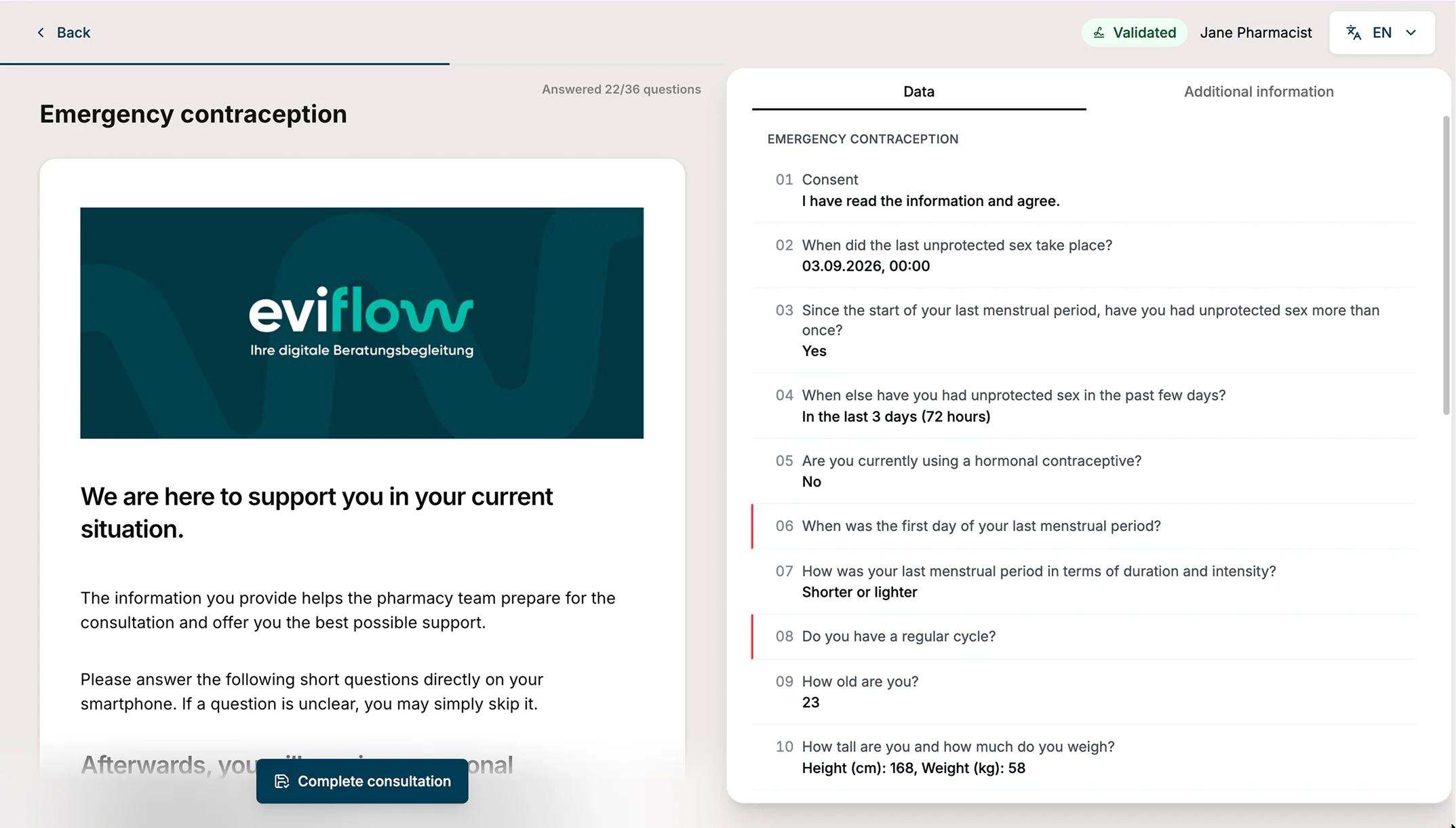
The platform lets Super Admins build and publish consultation forms, Administrators authorize devices and staff, pharmacists run and sign off consultations on a shared device, and patients privately answer their own questions before or during the visit.
The client approached Synterra to rebuild a first-generation version with a critical data-loss bug and confusing navigation — every change to a consultation flow also needed a developer. Synterra redesigned and rebuilt the platform from the ground up, working closely with the client's founder and technical lead.
What Was the Client's Request for Collaboration?
The client wanted to eliminate data loss and developer dependency from their pharmacy consultation tool.
Synterra was asked to rebuild the platform from the ground up, including:
- Reliable data capture that survives connection drops
- Simpler, more intuitive consultation navigation
- A self-service form builder for the internal team
- A Super Admin back office for pharmacy onboarding, licensing, and invoicing
- A UX redesign across all four user roles
What Was the Client's Bigger Business Goal?
The bigger goal was to get pharmacies to actually trust and stick with digital consultations instead of reverting to paper — turning a fragile, embarrassing process into a reliable, legally compliant workflow.
That meant:
- Conduct structured consultations via dynamic forms
- Never lose consultation data, even when a connection drops
- Sign off consultations and retain them for the legally required 20 years
- Launch on a fixed timeline — pilot pharmacies live by June 2026
At What Stage Was the Client's Project?
The client had a validated product idea, pilot pharmacies already using a first-generation platform, and deep pharmaceutical domain expertise — but the platform didn't meet the requirements and wasn't flexible enough to build on.
What Was Missing
- Reliable offline data capture
- A self-service form builder
- Clear role separation between staff, admins, and patients
- A working Super Admin back office
- A coherent UX across all four roles
What Was the Expected Outcome?
- Fast PIN login for pharmacists sharing a device across shifts
- Device authorization by the Administrator — directly on the device, or via pharmacy email confirmation
- Configurable pharmacist access — from trainees to staff with sign-off rights
- Real-time medication interaction checks via the HCI Solutions API
- PDF export of consultation protocols from the archive, for record-keeping and printing
- A four-language platform ready to onboard pharmacy chains and groups
How Was the Result Measured?
The solution was validated through:
- Client demos every two weeks, walking through real, role-based flows end to end
- Every decision logged in a shared, versioned requirements record
- Automated test coverage — backend tests plus a growing Playwright end-to-end suite
- A staged rollout: pilot pharmacies in production first, then a full public launch on August 3, 2026
After the pilot launch, results were analyzed and several flows were adjusted to better match real-world pharmacy requirements before the full public launch.
How Did the Collaboration Work?
Synterra redesigned and rebuilt Eviflow end to end, working directly with the client's founder and technical lead.
The process was iterative:
- 47. Audit the existing platform and map out technical options for the rebuild
- 48. Design and develop in sprints with daily standups
- 49. Validate role-based flows with the client every two weeks
- 50. Refine requirements continuously in a shared, versioned log
- 51. Test, release, and roll out in stages — from pilot pharmacies to public launch
The partnership spanned architecture, product design, business analysis, frontend, backend, QA, and infrastructure — roughly 9 months from discovery to public launch.
What Tools Were Used?
Development
- FastAPI (Python)
- React / Next.js
- SurveyJS (customized)
- PostgreSQL
- RxDB
- Casbin
- pytest
- Playwright
- GitHub Actions
Design and Integrations
- Figma
- Jira
- Zoom / Teams
- Signal
- ExoScale (Swiss hosting)
- Quill Editor
- HCI Solutions API
How Did We Add Value Beyond Delivery?
Before writing code, Synterra weighed building a custom form engine against using SurveyJS. A custom engine would have eventually reimplemented most of what SurveyJS already does — versioned schemas, conditional logic, calculated fields, translations — in roughly double the time. We chose the self-hosted, open-source SurveyJS instead, then extended it well beyond default use: dual synchronized views from a single schema, custom widgets like medication comparison, and role-based question visibility.
The Super Admin's license and payment management needs weren't specified at the start of the project. Synterra designed and built a full license and payment layer — setting license type and duration, tracking invoice status, and manually switching a pharmacy to read-only once its license expires.
Challenges
Undocumented Legacy Flows
The client's old system was confusing and undocumented — it wasn't clear which flows were intentional requirements and which were just accidental leftovers of the old implementation.
Solution: Synterra rebuilt the flows from scratch together with the client, based on real user needs rather than "how it used to be." The initiative and proposed solutions came from our side.
Data Loss on Connection Drops
Consultation data was lost whenever the internet dropped — a pharmacist could lose thirty minutes of conversation with a patient and have to start over live. This pushed pharmacies away from the digital tool.
Solution: Offline autosave — data is written locally on the device and synced once a connection is available. Data is no longer lost.
Rigid Forms vs. Paper Habits
Overly strict digital forms — required fields, a hard "draft" state — pushed pharmacies back toward paper.
Solution: Adopted a "paper parity" principle: a form can be submitted unfilled, with no strict validation, just like a paper form.
20-Year Legal Retention vs. Editable Forms
Consultations must legally be retained for 20 years, but the product's forms keep changing over time — while past consultations must remain provably unchanged.
Solution: Each consultation is tied to the exact form version it was filled out with. Updating the form doesn't touch old records — they stay preserved in their original form forever.
Multiple Languages, One Shared Device
Switzerland has multiple official languages, and pharmacies serve patients across different regions — a single static interface language wouldn't work for everyone.
Solution: A pharmacy sets a default interface language, but each pharmacist or Administrator can switch to their own language personally — the system remembers it, so on a shared device everyone sees the interface in their own language after logging in.
Real-Time Medication Interaction Checks
Checking a patient's current medications against the consultation drug meant real-time interaction logic across several medications at once — not a simple single-item lookup.
Solution: Built a custom SurveyJS medication comparison widget that queries the HCI Solutions API in real time on every check, with Super Admins able to pre-set default medications per form to speed up repeat use.
Achievements
What Was the Result?
Before:
- Pharmacists lost consultation data on connection drops, damaging trust in front of patients
- Confusing, undocumented flows
- Every form change required manual developer work
- Confusing, over-complicated login and device-authorization flow
- License and payment tracking handled with no dedicated tools
- One static interface language, even though pharmacies serve patients across different regions
- Rigid, all-or-nothing digital forms that didn't match how paper consultations actually worked
- No way to check a patient's medications against the consultation drug
- No fixed link between a consultation and the form version used to fill it, risking 20-year retention compliance
After:
- Offline-resilient consultation flow — in-progress data can no longer be lost
- Flows rebuilt from scratch around real user needs
- A self-service form builder the client's team uses without engineering support
- Fast, shift-friendly PIN login and admin-managed device authorization
- A Super Admin role built from scratch — full license and payment management, plus pharmacy onboarding
- A four-language platform, with each user choosing their own interface language
- Forms with paper parity — no strict validation, matching how pharmacists actually work
- Real-time medication interaction checks via the HCI Solutions API
- Every consultation permanently linked to the exact form version used, meeting the 20-year retention requirement
Tech Stack

React

Next.JS

FastAPI

PostgreSQL
Team

2 Front end

1 Back end

1 Business Analyst

1 UX/UI Designer

1 QA


