



Team
6 members

Timeline
5 months

Country
France

Industry
Entertainment
About Project
Who was your client
Le Petit Musée du Vin — the only wine museum in Lyon, France. Preparing to open to the public. Target audience: wine enthusiasts and tourists who want to learn about winemaking in an accessible way.
What was the client's request for collaboration
The client came with a clear vision documented in detailed technical specifications. They wanted to create an engaging, gamified museum experience — not traditional text plaques. Their reference point: Duolingo's approach to education through interaction and engagement.
Their primary concerns:
- Timeline: Museum opening date was fixed — they couldn't miss it
- Budget: Had to stay within allocated funds
- Independence: Explicitly stated they didn't want to depend on developers for content updates. Museum staff needed to edit text, images, and videos themselves.
Our initial scope of work: After analyzing their documentation, we prepared a proposal with detailed timeline and cost breakdown.
What is the client's bigger business goal
Position Lyon's only wine museum as a modern educational destination for complete beginners.
Business model: interactive education → informed visitors → tasting & wine sales.
Success metric: engagement that drives revenue and word-of-mouth.
At what stage was the client's project (point A)
What the client had prepared:
- Clear technical specifications: Detailed requirements document describing 14 interactive modules covering winemaking from soil to vinification
- Content foundation: Partial text content already written for modules
- Fixed constraints: Budget and timeline locked in. Museum opening date non-negotiable.
- Target experience: ~1 hour visitor journey through self-guided interactive education
What was missing:
- Software platform (no code existed)
- Interactive design and UX (no wireframes, no visual direction)
- Content management system for non-technical staff
- Media assets (illustrations, interactive visualizations, games)
Starting point: The client had a vision and requirements — but no technical implementation. They needed a team to turn their documented concept into a working system that museum staff could maintain independently.
What was the expected outcome of the contract
For Visitors:
- Learn winemaking through hands-on interaction, not just reading text
- Explore at their own pace in their preferred language (7 languages)
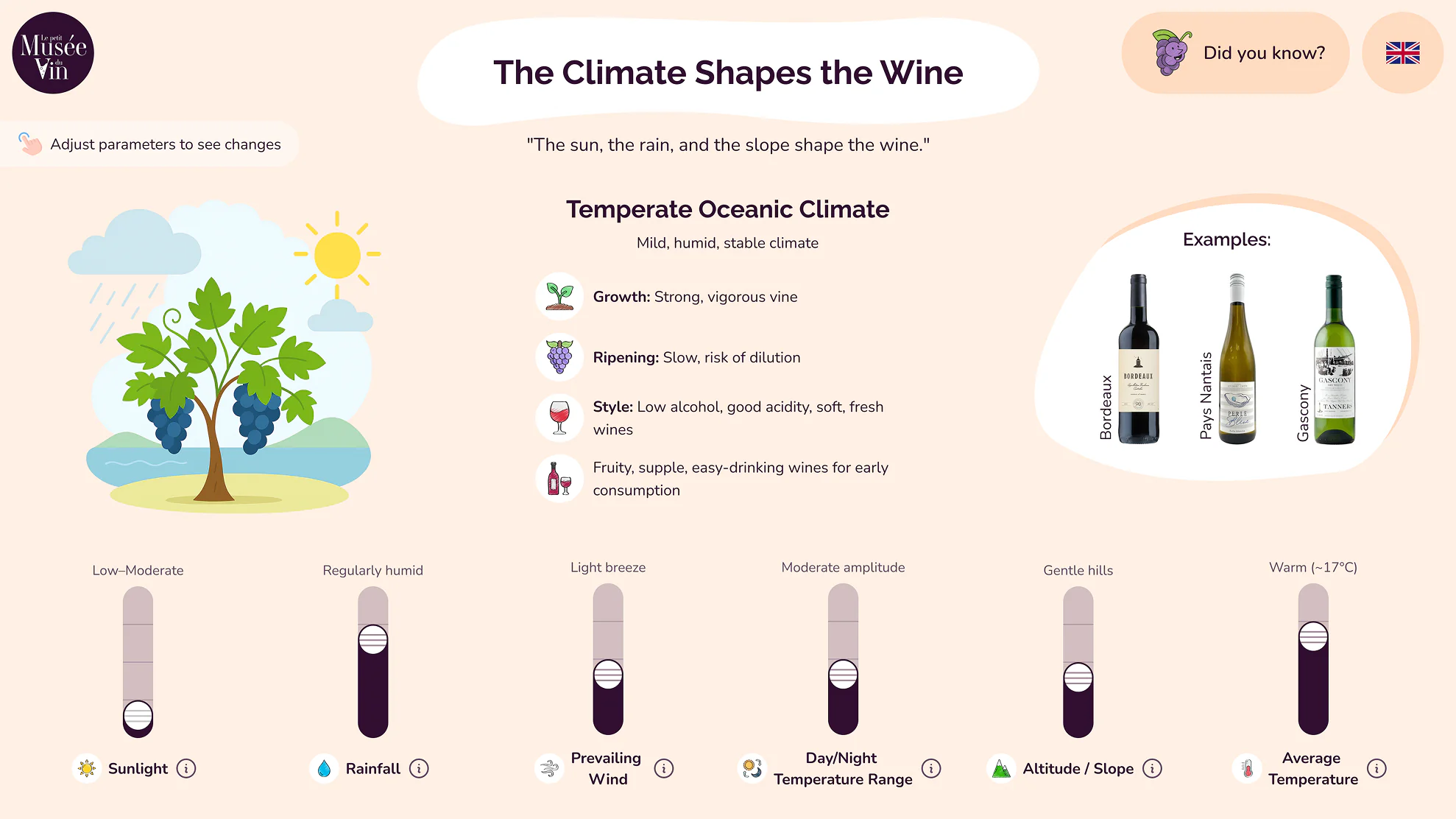
- Understand complex processes visually (adjust parameters → see results change in real-time)
- Retain information better through quizzes and interactive games
- Complete education in ~1 hour through 14 self-guided modules
For Museum:
- Content independence: Staff can update text, images, and videos without developer involvement
- Offline reliability: System works without internet connection
- Scalability: Modular architecture allows adding new modules in the future
- Revenue integration: Educational kiosks lead visitors to Tasting & Sales area
How the result was measured
Analytics Integration (Mixpanel):
Analytics tracking was planned to measure visitor behavior across the experience
- Time spent per module and screen
- Completion rates for modules and quizzes
- Language preferences
- Drop-off points in visitor journey
Analytics (30-day period, 1,919 visitor sessions):
- Engagement validation: ~182 seconds average dwell time per module (~3 minutes) — visitors actively read and interact, not just scroll
- Complex topics hold attention: Modules with detailed fermentation and aging content (Modules 6, 9, 10) keep visitors engaged for 12-13 minutes each. Heavy illustration and information density work when presented interactively.
- 97% quiz completion rate — visitors participate through the entire experience, not just browse
Business validation:
- Museum opened on schedule
- 4.9/5 Google rating with visitor feedback praising engagement, multi-language accessibility, and professional presentation
- Staff successfully update content independently (no developer dependency)
- Zero system downtime (100% offline reliability)
What the museum gained: Analytics dashboard gives real visibility into what works. The museum now knows that detailed, illustration-rich content keeps visitors engaged longer — validating their investment in interactive education over traditional text plaques. They can make data-driven decisions about which modules to expand and where to focus translation efforts for growing international tourism.
How the collaboration went
Communication:
- Regular demos: Showed completed modules live, collected feedback, adjusted direction
- Daily communication via Messenger for quick questions, Figma for design decisions, video calls for bigger discussions
- Visual updates instead of reports: Sent Figma prototypes and screen recordings
Flexibility during the project:
- Scope change mid-development: Client replaced one module with a different topic. We adjusted architecture and workflow to absorb the change while keeping the museum opening date on track.
- Analytics added mid-project: Client realized they needed visibility into visitor behavior. We integrated Mixpanel without delaying the launch timeline.
This kept the client in the loop at every stage. Result: a product that matched their vision, delivered on time, with a content management system they actually use.
Challenges
Spin the Terroir Mini-Game:
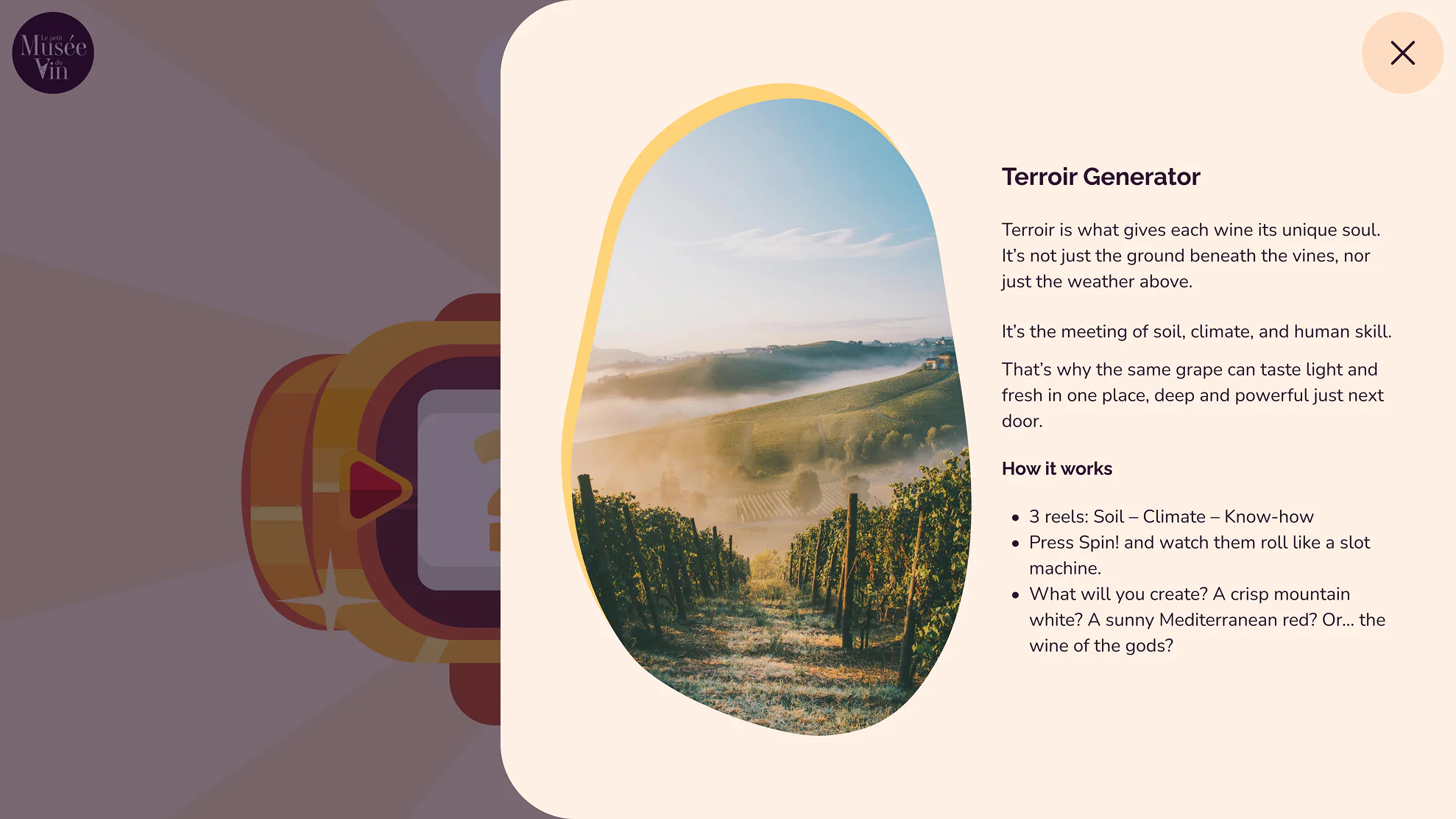
One module required an animated slot-machine interaction where visitors spin three reels — soil type, climate, and vineyard management — to land on a combination and see the resulting wine profile. Challenge: cover 300+ possible combinations and animate each one so it felt realistic and responsive, not like a generic random generator. Solution: built a structured outcome system (WIN, JACKPOT, LOSS) with reusable animation logic, so every combination produced a believable, properly explained result without hand-building hundreds of unique screens.
Module Replacement Mid-Project:
Wireframe review revealed one module too weak. Client replaced it entirely. Wireframes saved 30-40% rework time vs changing post-design. Analytics later validated the decision — strong engagement on replaced module.
7-Language Layout:
RTL (Arabic), character scripts (Chinese/Japanese), long compounds (German), varying text expansion. Challenge: keep layouts balanced across all languages. Solution: flexible UI components with adaptive spacing, tested across all 7 languages during design.
Late-Stage Analytics:
Client requested Mixpanel near project end. Challenge: retrofit tracking without breaking code or delaying launch. Solution: minimal-change integration, instrumented key events without refactoring. Result: analytics live at opening.
Achievements
What we did beyond just work
Custom Wine Education Assets: Stock libraries don't cover fermentation chemistry, soil composition, barrel aging. Created custom illustrations using AI tools for speed and consistency. Designed for complete beginners.
Content Validation: Researched winemaking ourselves to verify content makes sense to non-experts. Ensured modules teach, not just display information.
What was the result of our collaboration
BEFORE (pre-launch):
- Content concept documented but no implementation
- No system for museum staff to manage content independently
- Unable to measure visitor engagement
- Risk of not opening on time due to technical complexity
AFTER (post-launch):
- Museum opened on schedule
- Staff update content independently via Edit Mode
- 100% offline reliability — zero downtime
- Analytics-driven optimization (visitor behavior data guides content decisions)
- Strong visitor reception: 4.9/5 Google rating
Visitor feedback highlights:
- "The explanations were engaging, interactive, and available in multiple languages"
- "Very fun for young and old!"
- "The museum is really well done"
- "We learned a lot during the visit. The explanations were fun and interactive"
Where the client advanced in implementing their project
From concept to operational museum: Client started with technical specifications and a vision. Five months later, they opened Lyon's only wine museum — on schedule, fully functional, running autonomously offline.
From implementation to optimization: With the system live and analytics running, the museum entered the next phase: data-driven improvement. They now analyze visitor behavior metrics to refine content:
- Which modules hold attention longest
- Where quiz completion drops
- Which languages need content expansion based on visitor demographics
From gamification to engagement: The Spin the Terroir mini-game is a concrete example of the museum's gamified-learning approach in practice: instead of reading about how soil and climate shape wine, visitors spin, experiment, and see the result for themselves. It's one of the clearest illustrations of why the museum chose interactive education over text plaques — the kind of engagement that, combined across all 14 modules, supports the broader goal of sending informed, curious visitors toward the Tasting & Sales area.
What's next for the client:
- Expand module library based on analytics insights
- Refine existing modules using real engagement data
- Potentially scale the system (new museum locations or licensing to other wine education venues)
The foundation is built. The museum now has both the technology and the data to evolve their visitor experience continuously.
What was the client's feedback
"Maksym and his team delivered a high-quality desktop application using Electron and React. The app is offline-first, fast, and reliable, with strong performance and solid architecture. They integrated analytics with Mixpanel and handled complex requirements with a structured, problem-solving approach. Communication was clear, and all issues were resolved efficiently. I would highly recommend them for desktop app development, Electron, React, AI automation, and performance-critical projects."
Tech Stack

React

Electron

i18n

JSON

Google Cloud Storage

Motion

Figma
Flow
Initial briefing
We defined the museum's educational goals and mapped visitor journeys, including content audit, user scenarios, and identifying engaging interaction opportunities for wine learning.
Designing a team
A cross-functional team of UX/UI designers, developers, and project manager aligned design, technology, and storytelling with clear workflows and feedback loops.
Engineering
Interfaces were developed as an offline React/Electron application for smooth local performance, with flexible content management and scalability for future exhibits.
Testing
Each module was tested for usability, screen orientation (vertical/horizontal), multilingual accuracy, and performance stability.
Launch
The experience was deployed across 14 interactive stations in the museum, each featuring 10–13 themed modules. All stations were configured to operate independently while maintaining consistent analytics and design behavior.
Support
We provide ongoing maintenance, content updates, and analytics insights. The system remains expandable for new modules and experiences.
Team

2 Designers

1 Project Manager

2 Front end

1 QA


