



Team
3 members

Timeline
6 months

Country
Caribbean Islands

Industry
Hospitality
About Project
Who Was the Client?
IslandMetrics is a sustainability data platform for Caribbean hotels and resorts, founded by someone with a background in hotel operations. The founder saw that hotels had no structured way to track how efficiently they use energy and water, or to report on it — most properties were relying on spreadsheets and year-end compliance exercises instead of ongoing operational visibility.
He used AI tools to shape the concept and get the interface direction right. Turning that into a real, working product was where things stalled — that's the exact gap we help founders like this close.
What Was the Client's Request for Collaboration?
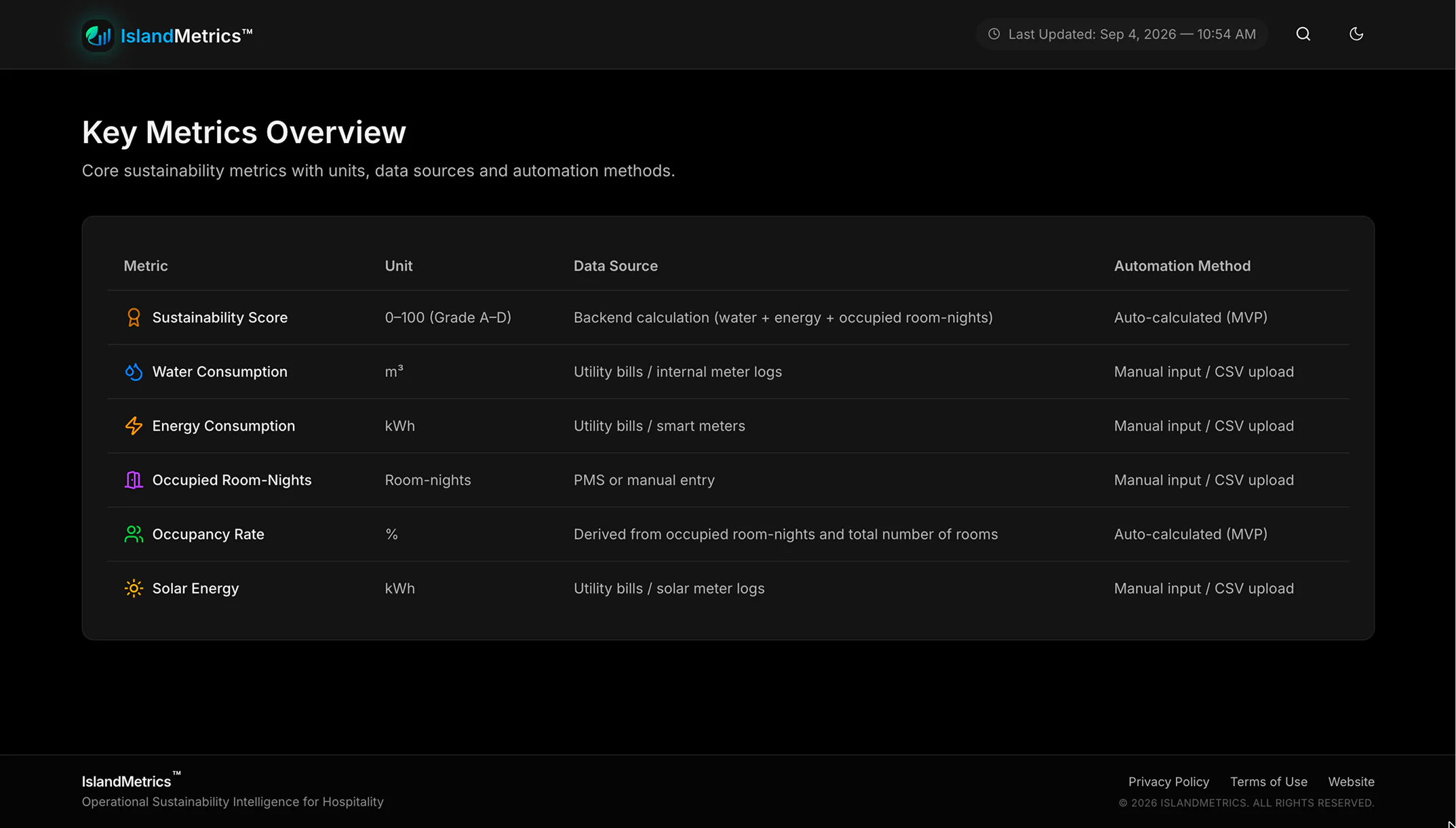
At the stage when the founder came to us, he had a Tailwind-based UI reference and detailed documentation of how the product should work — a solid starting point for direction, but not yet something ready to build on. Before diving in, we went through it to see what could carry forward as-is and what needed to be built from the ground up; the visual direction held up well as a reference, while the backend and data logic still needed to be created.
The vision kept evolving as we built — a lot of what shipped ended up different from the original plan, even though the core concept stayed the same. We owned frontend, backend, and QA end to end.
What Was the Client's Bigger Business Goal?
IslandMetrics wants to become the standard operational layer for sustainability measurement across Caribbean hospitality. The business goal was to:
- Replace fragmented spreadsheets and year-end sustainability reporting with a structured, monthly operational system
- Give hotel leadership (GMs, owners, engineering teams, hospitality groups) a consistent way to measure and compare resource efficiency across properties
- Apply AI-driven analysis to historical resource data, turning raw consumption records into an efficient management tool for hotel teams
- Build a long-term, property-level performance record that supports due diligence, financing conversations, and asset evaluation over time
- Help hotels respond to guests who increasingly factor sustainability into where they stay
At What Stage Was the Client's Project?
What the client had:
- Extensive written documentation describing the intended metrics, scoring, and reporting logic — though the requirements were dense and evolved substantially as the product took shape
- An AI-generated UI concept (Tailwind components) showing the intended look and feel — not functional software
- Domain knowledge from hospitality operations, shaping the core problem the product needed to solve
- A fixed general timeline for launch, working solo as a founder with no team of his own
What was missing:
- A working frontend or backend — the concept existed only as a visual mockup
- A data model for capturing operational metrics
- A reporting system — PDF generation, scoring logic
- QA coverage
- A structure for handling multi-property or multi-user access
What Was the Expected Outcome?
- A dashboard giving hotel teams live visibility into energy, water, and resource consumption — not just a snapshot at year-end
- Consumption normalized against occupied room-nights, so properties could be compared on efficiency rather than raw usage, rolled up into an A-to-D sustainability grade
- Cost impact calculated from each property's own utility rates — both total and per occupied room-night
- Automated monthly PDF reports with sustainability scoring, replacing manual spreadsheet work
- Onboarding and access management built for hospitality groups managing more than one property, not just a single hotel
- Automated reminders that keep monthly reporting on track without anyone having to chase it manually
How Was the Result Measured?
IslandMetrics is still in its early access phase, onboarding its first properties, so adoption and revenue metrics aren't available yet.
There was no existing product to benchmark against, so success here meant something more specific: delivering a platform that matched the founder's evolving vision and held up under real use.
- Feature completeness: dashboard, flexible data input, PDF reporting with sustainability scoring, multi-property access management, and automated reminders — full scope delivered
- Fidelity to the vision: despite repeated changes along the way, what shipped is the product the founder recognizes as what he set out to build
- Launch readiness: stable enough to onboard real hotel properties into early access
How Did the Collaboration Work?
The founder's documentation was extensive, so we started by working through it systematically — breaking it into structured blocks, identifying inconsistencies, and resolving them into a coherent picture of how the product should actually function. From there, we moved into building the platform itself.
The process stayed dynamic throughout — individual features shifted as the founder refined his vision — but the overall direction held steady, which let us keep building without losing momentum. The founder stayed closely involved at each stage, since he was the one shaping the product as it took form. That's the kind of engagement we're built for: taking a concept that's still moving and turning it into something concrete, without losing time to the uncertainty along the way.
Challenges
Interpreting conflicting requirements.
The founder's specifications arrived as long documents — sometimes 30 pages — describing many features at once. Some features referenced others that didn't exist elsewhere in the document, or described behavior that contradicted an earlier section.
Solution: Rather than build against an ambiguous spec, we worked through the documents feature by feature, flagged contradictions and gaps back to the founder, and revised our understanding repeatedly until the logic held together consistently across the platform.
Scope that kept moving against a fixed deadline.
The founder refined the product's direction multiple times over the course of the engagement, but the launch timeline stayed fixed throughout.
Solution: We absorbed each round of changes into the existing build incrementally, rather than treating scope changes as reasons to reset the timeline.
Building AI Insights without a template to follow.
Since this feature came from us, not the founder's original spec, there was no existing logic to build against — we had to define what counted as a meaningful pattern in a property's historical data, and turn that into monthly recommendations that would actually be useful to a hotel team, not just statistically true.
Solution: We grounded the feature in patterns with clear operational relevance — like seasonal consumption spikes — so it produces recommendations a hotel manager could act on, not a wall of numbers.
Achievements
How Did We Add Value Beyond Delivery?
Being fully immersed in the project — close to the data and the product logic — we spotted a way to make the product more valuable: AI Insights, a feature that looks at a property's historical data and surfaces patterns worth acting on. For example, flagging that a property's energy use climbs roughly 30% every summer and suggesting it's worth evaluating solar.
We presented the concept to the founder, he approved it, and we implemented it as a recurring monthly analysis — so recommendations stay current with each new reporting period rather than reflecting a single point in time.
What Was the Result?
Before:
- A concept shaped by AI tools and hospitality domain knowledge, but no working software behind it
- Dense, evolving documentation describing the intended metrics, scoring, and reporting logic — with no data model or backend to run it
- An AI-generated UI reference (Tailwind components) showing the intended look, but not functional
- No infrastructure for onboarding hotel staff or managing property-level access
- No infrastructure for generating sustainability reports — only what could be tracked manually in spreadsheets
After:
- A working web platform (Next.js/NestJS/Supabase) covering data input, dashboards, and reporting
- Consumption normalized per occupied room-night, rolled up into an A-to-D sustainability grade with estimated cost impact
- Monthly PDF sustainability reports generated automatically from submitted data
- AI Insights surfacing patterns in historical data, refreshed monthly
- Multi-property onboarding, invitations, and access management for hotel staff
- Automated email reminders that keep monthly reporting on track without manual chasing
- A platform ready to onboard real hotel properties into early access
Tech Stack

Next.JS

NestJS

Supabase

RTK Query

Resend

Tailwind
Flow
Clarify
Resolved contradictions in the spec
Structure
Turned 30-page docs into a coherent model
Build
Shaped the platform around that logic
Deliver
Scope kept shifting, deadline held
Team

1 Front end

1 Back end

1 QA


